
What Is the Best Geotech Fabric for 2026?
Choosing the best geotech fabric for 2026 requires more than comparing prices or product colors. Project conditions must guide the decision. Soil type, groundwater movement, loading, climate, and installation quality all affect performance. A fabric that works beneath a rural access road may fail beside a coastal drainage channel.
Dr. John P. Giroud, a leading geosynthetics engineer, once stated, “Geosynthetics are not a substitute for good engineering.” That principle remains highly relevant. The best geotech fabric must match its intended function, whether separation, filtration, drainage, reinforcement, or erosion control. Engineers should examine tensile strength, puncture resistance, apparent opening size, permittivity, creep behavior, and ultraviolet stability. Manufacturing consistency matters too.
Field experience often reveals what laboratory data misses. Sharp aggregate can damage fabric during placement. Poor overlaps can create weak seams. Clogged pores can reduce drainage performance. Small details matter.
There is no universal winner.
This 2026 guide will compare woven and nonwoven geotextiles, reinforced composites, and emerging material options. It will consider lifecycle value rather than initial cost alone. Installation conditions, regional climate, and maintenance access will receive equal attention. Some recommendations may remain uncertain because long-term field data is still limited for newer products. That uncertainty deserves honest discussion. A technically impressive fabric can still be the wrong choice when specifications, soil conditions, or construction practices are misunderstood.
Define Geotextile Roles: Separation, Filtration, Drainage, and Reinforcement
What Is the Best Geotech Fabric for 2026?
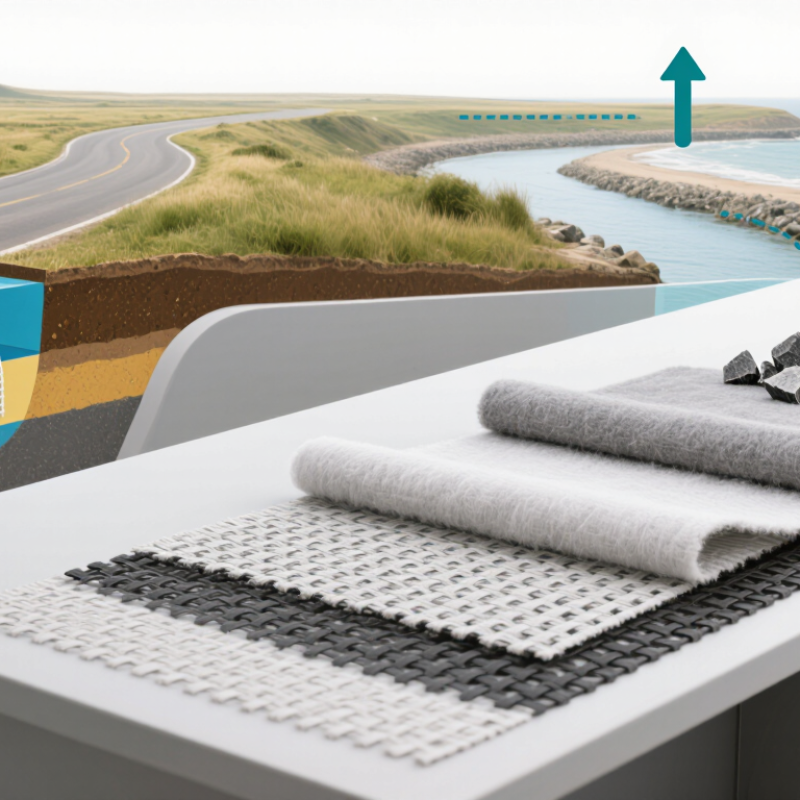
The best geotextile depends on its assigned role, not its label. FHWA’s Geosynthetic Design and Construction Guidelines, Report No. FHWA-NHI-07-092, separates performance into separation, filtration, drainage, and reinforcement. A fabric beneath a road must prevent soil migration. It must also keep aggregate from sinking into soft subgrade. That balance matters.
For filtration, pore size and permeability control success. ASTM D4751 measures apparent opening size, while ASTM D4491 measures permittivity. Engineers should compare these results with soil grading and hydraulic pressure. A recent industry outlook places geotextile demand growth near 6% annually through 2030. That growth reflects wider use in roads, drainage layers, erosion control, and retaining structures. Still, market growth does not prove suitability.
For drainage, choose a fabric that passes water without carrying fine particles. For reinforcement, tensile strength, elongation, and installation damage deserve closer review. AASHTO M288 provides application classes, but field conditions can exceed laboratory assumptions. Site experience often shows a simple mistake: designers select high strength without checking clogging risk. I would question that choice. Wet soil changes everything. A stronger fabric is not always the better fabric. Careful testing, documented soil data, and installation inspection remain more reliable than a product sheet alone.
What Is the Best Geotech Fabric for 2026? — Define Geotextile Roles: Separation, Filtration, Drainage, and Reinforcement
The best geotextile depends on the required engineering function, soil conditions, hydraulic demand, installation stresses, and long-term durability requirements.
| Geotextile Role | Primary Engineering Function | Preferred Fabric Structure | Common Polymer Options | Typical Opening or Permeability Considerations | Typical Applications | Main Selection Criteria | Key Limitation |
|---|---|---|---|---|---|---|---|
| Separation | Prevents different soil or aggregate layers from mixing while allowing water to pass through the system. | Needle-punched nonwoven or woven fabric, selected according to subgrade strength and aggregate loading. | Polypropylene or polyester. | Opening size should retain the surrounding soil while maintaining adequate flow; design commonly considers apparent opening size and soil gradation. | Road subgrades, unpaved roads, railway formations, working platforms, and aggregate-over-soil interfaces. | Subgrade CBR, puncture resistance, tensile strength, installation damage resistance, and soil retention. | A separation geotextile alone does not replace structural base thickness or solve inadequate subgrade bearing capacity. |
| Filtration | Allows water to flow through while limiting the migration of soil particles into drainage layers or outlets. | Usually needle-punched nonwoven fabric with a three-dimensional pore structure. | Polypropylene is common; polyester may be used where specific strength or dimensional requirements apply. | Hydraulic conductivity should be greater than the surrounding soil system’s required flow demand; opening size must be compatible with soil particle distribution. | Underdrains, retaining walls, drainage trenches, erosion-control systems, and leachate collection layers. | Apparent opening size, permittivity, permeability, clogging resistance, soil compatibility, and chemical exposure. | Incorrect pore sizing can cause clogging or soil piping, especially in broadly graded, dispersive, or internally unstable soils. |
| Drainage | Conveys water or gas within the plane of the geotextile or as part of a drainage composite. | Thick nonwoven geotextile, geonet-geotextile composite, or prefabricated drainage geocomposite. | Polypropylene or high-density polyethylene components, depending on the product configuration. | In-plane transmissivity is the critical parameter and must be evaluated under the expected normal stress and hydraulic gradient. | Basement walls, bridge decks, landfill drainage systems, road edge drains, tunnel linings, and foundation drainage. | Transmissivity under load, compressive creep, filter compatibility, discharge capacity, and connection details. | Drainage capacity can decrease under sustained compression, bending, clogging, or poor outlet design. |
| Reinforcement | Improves load distribution and tensile resistance in soil structures by controlling lateral deformation and stabilizing weak layers. | High-strength woven geotextile or geogrid; a geotextile is selected when filtration or separation is also required. | Polyester, polypropylene, or high-modulus polymer yarns, depending on the design strength and creep requirements. | Hydraulic opening size is secondary to tensile strength, junction or seam performance, soil interaction, and long-term design strength. | Embankments over soft soil, reinforced soil slopes, mechanically stabilized earth structures, basal reinforcement, and haul roads. | Long-term tensile design strength, creep reduction factor, installation damage, durability, interface friction, and strain compatibility. | Reinforcement performance is highly dependent on anchorage, confinement, installation quality, and accurate soil-structure design. |
| Project Condition | Recommended Starting Point | Why It Fits | Critical Verification Tests or Data |
|---|---|---|---|
| Soft, fine-grained subgrade beneath aggregate | Heavy-duty nonwoven or woven separation geotextile with strong puncture and tensile resistance. | Limits aggregate intrusion and soil pumping during construction traffic. | CBR puncture, trapezoid tear, tensile strength, apparent opening size, and installation damage assessment. |
| Clean sand or gravel drainage layer adjacent to soil | Nonwoven filtration geotextile selected for soil retention and hydraulic conductivity. | Maintains drainage flow while reducing migration of fines into the drainage medium. | Soil gradation, apparent opening size, permittivity, permeability, and clogging evaluation. |
| Retaining wall or basement wall requiring continuous water relief | Drainage geocomposite with a compatible filter fabric and a reliable collection outlet. | Provides a defined in-plane flow path and reduces hydrostatic pressure when properly connected. | Transmissivity under design load, compressive creep, filter performance, and outlet capacity. |
| Embankment or road over weak soil | High-strength woven reinforcement geotextile or geogrid, often combined with a separate filter layer. | Improves load distribution and limits lateral spreading during staged construction. | Long-term design strength, creep, installation damage, interface friction, and deformation limits. |
| Exposure to ultraviolet light, chemicals, or elevated temperatures | Polymer and stabilization system selected from documented durability data rather than fabric type alone. | Environmental exposure can govern service life even when initial mechanical properties are adequate. | UV resistance, oxidation resistance, chemical compatibility, temperature limits, and project-specific service-life calculations. |
Related Posts
-
What Is the Best Driveway Fabric for Gravel?
-
2026 How to Choose Heavy Duty Landscape Fabric for Your Project
-
Why is Geotextile Fabric Essential for Modern Construction Projects?
-
10 Essential Tips for Choosing the Right Filter Fabric for Your Needs?
-
Top 10 Benefits of Using Landscape Fabric for Your Garden?
-
10 Best Road Fabric Options for Durable Pavement Solutions?