
2026 Top Geotextile Membrane Types for Global Buyers
Global buyers entering 2026 face a wider geosynthetic market, but selection remains highly site-specific. Grand View Research reports that the global geosynthetics market reached approximately USD 12.6 billion in 2023, with continued growth expected through 2030. Its category includes geotextiles, geomembranes, and related products. Therefore, market growth does not automatically identify the right geotextile membrane for every project.
Performance depends on soil, drainage, ultraviolet exposure, installation stress, and long-term chemical contact. A woven polypropylene membrane may suit separation beneath access roads. A nonwoven polyester membrane can provide filtration around drainage aggregate. In landfill or water-containment systems, buyers often require stronger barrier products and carefully verified seam performance. Small differences matter.
J.P. Giroud, a pioneer in geosynthetics engineering, is widely associated with the warning, “Geosynthetics are not a substitute for good design.” That principle still deserves attention. A low unit price can become expensive after punctures, clogging, or difficult installation. The Geosynthetic Institute and ISO testing guidance also emphasize measurable properties, including tensile strength, apparent opening size, permittivity, and resistance to installation damage. These figures should be checked against project conditions, not copied from a brochure.
This 2026 guide compares leading geotextile membrane types for international purchasers. It considers material structure, application fit, durability, compliance documentation, and supply reliability. Some categories overlap. Some product claims remain unclear. That is precisely why careful comparison matters before purchase.
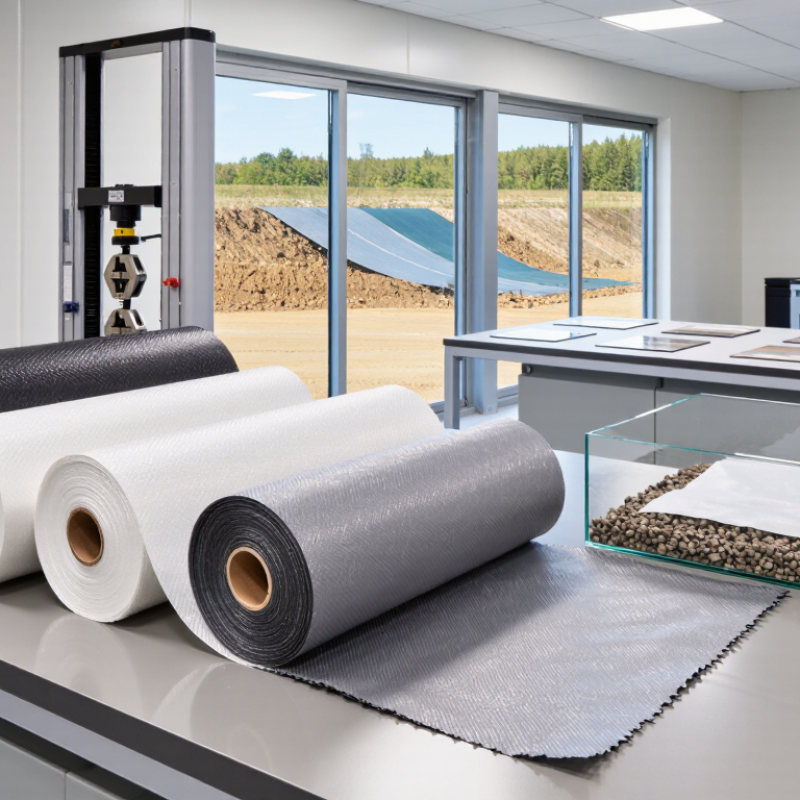
Geotextile Membrane Types: Woven, Nonwoven, Composite, and Geomembrane
2026 Top Geotextile Membrane Types for Global Buyers
Geotextile Membrane Types: Woven, Nonwoven, Composite, and Geomembrane
Global demand is becoming more technical, not simply larger. Grand View Research estimated the geotextiles market at about USD 8.2 billion in 2023, with growth continuing through 2030. Woven geotextiles suit roads, embankments, and heavy-load separation. Their compact structure offers strong tensile performance and controlled soil movement. Nonwoven materials work differently. Their needle-punched fibers provide filtration, drainage, and cushioning around pipes or liners. Site reality is messier.
Composite geotextiles combine functions in one engineered layer. A drainage core may connect with filtration fabric, reducing installation steps and possible interface errors. The U.S. Environmental Protection Agency’s landfill guidance identifies composite liner systems as important barriers against liquid migration. However, buyers should check chemical compatibility, seam design, puncture resistance, and temperature limits. A lower purchase price can create higher inspection costs later.
Geomembranes are not geotextiles, but they often work together. These polymer sheets provide the primary hydraulic barrier, while geotextiles protect them from sharp aggregate and construction traffic. The Geosynthetic Institute’s technical guidance emphasizes site-specific testing, including tensile strength, tear resistance, and seam performance. I would not choose by thickness alone. Soil chemistry, ultraviolet exposure, installation quality, and long-term settlement matter more than a neat product table. One detail is often missed: drainage capacity can decline under sustained compression.
2026 Top Geotextile Membrane Types for Global Buyers
Geotextile Membrane Types: Woven, Nonwoven, Composite, and Geomembrane
| Material Type | Typical Polymer | Manufacturing Structure | Primary Function | Typical Mass Range | Hydraulic Behavior | Key Performance Characteristics | Common Applications | Main Purchasing Considerations |
|---|---|---|---|---|---|---|---|---|
| Woven Geotextile | Polypropylene or polyester | Interlaced machine-made yarns or tapes forming a regular grid | Separation, reinforcement, filtration, and load distribution | Approximately 90–700 g/m² | Usually permeable; water passes through the openings between yarns | High tensile strength, low elongation, strong soil stabilization, and good puncture resistance | Road bases, haul roads, rail formations, embankments, working platforms, and soil reinforcement | Confirm tensile strength, apparent opening size, seam strength, UV resistance, and roll dimensions |
| Nonwoven Geotextile | Polypropylene or polyester staple fiber or continuous filament | Randomly arranged fibers bonded mechanically, thermally, or chemically | Filtration, drainage, separation, cushioning, and erosion control | Approximately 100–1,200 g/m² | Permeable, with relatively high water flow capacity when properly selected | High elongation, effective soil retention, conformability, and good resistance to installation damage | Drainage layers, retaining walls, landfills, coastal protection, French drains, and pipe wrapping | Review permittivity, transmissivity, apparent opening size, puncture resistance, and clogging behavior |
| Composite Geotextile | Typically polypropylene or polyester combined with a polymer drainage core | Two or more integrated layers, such as geotextile–geonet or geotextile–geogrid | Combined filtration, drainage, separation, and reinforcement | Approximately 400–2,500 g/m², depending on the core and layers | Permeable; in-plane drainage performance depends on core thickness and applied pressure | Multifunctional performance, reduced installation steps, controlled drainage paths, and efficient space use | Landfill leachate drainage, basement waterproofing systems, green roofs, tunnels, and drainage beneath pavements | Check transmissivity under load, interface friction, long-term compression, filter compatibility, and layer bonding |
| Geomembrane | HDPE, LLDPE, PVC, EPDM, or other flexible polymer formulations | Continuous polymer sheet produced by extrusion or calendaring | Liquid and gas containment; hydraulic barrier formation | Approximately 0.5–3.0 mm thickness; areal mass varies by polymer and thickness | Practically impermeable when correctly manufactured, welded, and installed | Very low permeability, chemical resistance, high containment efficiency, and weldable seams for many grades | Landfill liners and covers, wastewater ponds, irrigation reservoirs, mining facilities, and secondary containment | Evaluate thickness, resin type, chemical compatibility, seam quality, stress-crack resistance, and installation temperature range |
Note: Performance ranges are typical industry reference values rather than universal specifications. Final selection should be based on project design loads, soil conditions, drainage requirements, chemical exposure, climate, and applicable standards.
Related Posts
-
Best Silt Fence Types for Erosion Control Solutions?
-

2026 Top Silt Fence Options for Erosion Control Solutions?
-
Best Erosion Control Blankets for Effective Soil Protection?
-

2026 How to Choose Polymeric Sand for Pavers Effectively?
-

China Top 10 Retaining Wall Blocks Manufacturers?
-
10 Essential Tips for Choosing Retaining Wall Blocks for Your Project?