
A Dual Frequency Card is designed to work with two different radio-frequency systems. Common examples include 125 kHz proximity readers and 13.56 MHz contactless readers, though the exact frequencies and protocols depend on the card. This can be useful when a building uses older access readers alongside newer equipment. One card may support both, but the label does not guarantee compatibility with every reader.
Inside the card, an antenna or coil captures energy from a nearby reader. The card’s chip then communicates using the supported frequency and protocol. Some designs use separate components for each frequency; others combine functions in a compact structure. The card does not simply switch between frequencies in every situation. It responds to the reader and system it was built to support. That detail matters.
Picture a reader mounted beside a door: bringing the card close may trigger a brief exchange of radio signals. If the card and reader use incompatible standards, nothing happens. A dual-frequency design also does not automatically make a card more secure; security depends on its chip, credentials, and system configuration. It is worth checking the manufacturer’s specifications before choosing one. Real-world compatibility can be less tidy than the product name suggests. A frequency number alone is not enough. This guide explains how dual-frequency cards work, what their components do, and which practical details to verify before use.
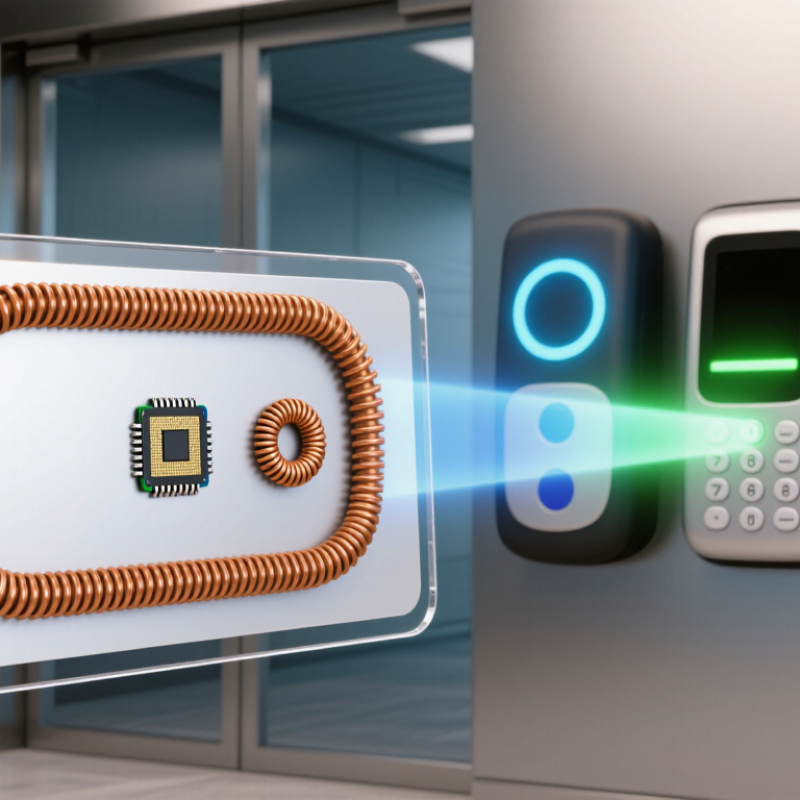
A dual frequency card is a single credential designed to communicate on two radio bands. Many access cards combine low-frequency RFID, often around 125 kHz, with high-frequency communication at 13.56 MHz. The NFC Forum’s technical materials identify 13.56 MHz as NFC’s operating frequency; ISO/IEC 18000-2 covers RFID below 135 kHz. These figures describe different radio technologies, not a promise that every card reader can handle both. Inside the card, separate antenna circuits or chips may support each band. A reader must also recognize the matching protocol. Two frequencies do not mean universal compatibility.
In practice, the card may let someone use one credential at older low-frequency door readers and newer high-frequency systems. The card itself does not decide which system grants access; the reader and its configured credential data do. Check the reader’s frequency and protocol before ordering or issuing cards. A card marked “dual frequency” can still fail at a particular door. That is an easy detail to miss.
Tips: Ask the system administrator to test a sample card on the actual readers. Note the frequency and protocol for each door, then keep a simple record. Small checks save time. I would still verify the card’s exact specifications; the label alone can be vague.
A dual frequency card is designed to communicate at two radio frequencies, often 125 kHz and 13.56 MHz. The exact pair depends on the card’s intended readers and system. These frequencies behave differently: low-frequency signals work over short distances, while 13.56 MHz supports common contactless communication standards. Neither frequency guarantees a particular read range; reader design and nearby materials also matter.
Inside, many cards use two separate antenna coils, each tuned to its own frequency, connected to one or more integrated circuits. A coil may look like a thin loop of wire embedded around the card’s edge. The chips store or process data and respond when a compatible reader supplies a radio field. Some designs combine functions differently, so “dual frequency” alone does not reveal the internal layout. It depends.
The card’s plastic layers protect these delicate parts, but bending or cutting can damage an antenna. A reader tuned to only one frequency may detect only one of the card’s functions. That distinction is easy to miss. For a reliable specification, check the stated frequencies, supported protocols, and reader compatibility rather than relying on the card’s label alone.
A dual-frequency card does not usually communicate with every reader at once. It has circuitry designed for two radio-frequency ranges, commonly a low-frequency band near 125 kHz and a high-frequency band near 13.56 MHz. Exact frequencies and protocols depend on the card. When a compatible reader is active, its antenna creates a nearby electromagnetic field. The card’s antenna coil picks up energy from that field, powering the chip in passive designs. No battery is needed. That detail matters.
The reader sends a command by changing its field in a pattern the chip can detect. The chip replies by altering the electrical load on its antenna, and the reader senses those small changes as data. This exchange may carry an identifier or other system data, depending on the design. A reader tuned to one frequency may miss the card’s other interface. Frequency and protocol must both match. In a practical test, a card may work beside one reader and stay silent beside another, even if the devices look similar. Appearance is a poor clue. Nearby metal, a damaged coil, or poor alignment can weaken communication. I would not assume “dual frequency” means greater range or stronger security; those depend on the card and system configuration.
| Aspect | Typical Details | How It Affects Communication |
|---|---|---|
| Meaning of “dual frequency” | A card designed to operate at two distinct radio frequencies, commonly low frequency (LF) and high frequency (HF). | The card can communicate with compatible readers for either supported frequency. It does not necessarily communicate with both at the same time. |
| Common LF band | Approximately 125 kHz or 134.2 kHz, depending on the card and system. | LF systems commonly use near-field inductive coupling. The reader’s magnetic field powers or signals the card over a short distance. |
| Common HF band | 13.56 MHz. | HF systems also commonly use inductive coupling. The exact communication method and supported features depend on the card’s protocol and reader. |
| Card components | A dual-frequency card may contain separate antenna structures and separate or integrated electronics for its two frequency interfaces. | When a reader generates a field at a supported frequency, the matching antenna and circuitry handle that link. |
| Reader field and card power | Many contactless cards have no battery and obtain operating power from the reader’s electromagnetic field. | The reader creates a field; the card couples to it and may use the harvested energy to respond. This is often called passive operation. |
| Data exchange | The reader sends commands or a polling signal, and the card returns data by modulating its response to the field. | The reader and card must use compatible frequency, protocol, and data settings. Frequency compatibility alone does not guarantee communication. |
| Examples of relevant standards | Some LF animal-identification systems use ISO 11784 and ISO 11785. At 13.56 MHz, examples include ISO/IEC 14443 and ISO/IEC 15693. | These standards describe different system requirements and communication behavior. A card and reader must support compatible standards to exchange data. |
| Reader selection | A reader must support the card’s operating frequency and the relevant protocol or application. | A single-frequency reader may detect only the matching interface, even when the card supports a second frequency. |
| Read range | Range varies with frequency, antenna design, reader power, card orientation, surrounding materials, and system configuration. | There is no universal read distance for dual-frequency cards; the supported system and installation determine practical performance. |
| Security and data access | Security features vary by card and protocol. Some systems use authentication or protected data, while others provide limited identification data. | A reader may need the correct credentials and procedures in addition to radio-frequency compatibility to access protected information. |
A dual-frequency card contains components designed to communicate at two radio frequencies. Many cards support 125 kHz and 13.56 MHz. Each frequency suits a different type of reader, so one card can serve more than one system.
The functions usually work through separate tuned circuits or chip components inside the card. When a reader creates a radio field, the component matched to that frequency responds and exchanges data. The other component typically stays inactive. They do not necessarily transmit together. In practice, this can feel less seamless than the name suggests: a card may support both frequencies but still fail with a reader using an incompatible data format. Frequency alone does not guarantee compatibility. Some designs also differ in how their antennas and chips are arranged, so performance can vary.
Tips: Check the card’s supported frequencies and data types against your readers. Test it at the actual reader, not just on paper. Test both. A small difference in reader setup can matter.
A dual-frequency card supports two radio-frequency bands, typically 125 kHz (low frequency) and 13.56 MHz (high frequency). Each band uses compatible card circuitry and an antenna; a reader communicates using the frequency it supports. The functions are available on the same card, but they do not necessarily operate simultaneously.
Dual-frequency cards are commonly used in buildings that still have older access readers but are upgrading their systems. A card may combine a 125 kHz proximity credential with a 13.56 MHz credential, letting it work across compatible door readers. Offices, university campuses, hospitals, and factories use this arrangement for staff entrances, lift access, and restricted rooms. One card can replace two, though each reader and credential must be configured to match.
They also appear in transport and hospitality settings, where operators may need one card for more than one compatible service. For example, a campus card might open a residence hall and identify its holder at a cafeteria reader. The wider RFID market reflects growing use of identification technology: Grand View Research’s 2023 RFID Market Size, Share & Trends Analysis Report valued the global market at USD 14.5 billion in 2022 and forecast continued growth. That figure covers RFID broadly, not dual-frequency cards alone. A useful distinction.
Tips: Ask the card issuer which frequencies and credential formats the card supports. Two frequencies do not guarantee compatibility; test it at the actual reader before replacing existing cards.
