
Skip to content

How to Choose the Best WPC 3D Wall Panels?

Choosing the best Wpc 3d Wall Panel starts with the room, not the showroom sample. Will it face steam, direct sunlight, or frequent cleaning? Those conditions affect the core, surface finish, and installation method. Grand View Research valued the broader global wood-plastic composites market at USD 7.49 billion in 2023 and projected growth through 2030. That figure covers many WPC products, not 3D wall panels alone. It signals a growing materials category, but it cannot verify any panel’s quality.

Dr. Michael P. Wolcott, a wood-plastic composites researcher at Washington State University, has published research on composite materials and their performance. A practical takeaway from that work, paraphrased rather than presented as a direct quotation, is to judge a composite by its formulation and intended service conditions. For buyers, that means checking the panel’s material composition, dimensional stability, surface coating, and documented installation requirements. Ask for technical data, not just attractive product photos. Details matter.

Look closely at a physical sample. Check the edges, the depth of the raised pattern, and whether the finish feels even under your fingertips. Then confirm how the panel handles moisture and heat in your specific space. Do not assume every WPC 3D Wall Panel suits every room. A small sample can also mislead; lighting and wall preparation change the final appearance. Compare warranties and care instructions, and ask the supplier what the documents do not explain. That extra question is easy to skip. It should not be.
How to Choose the Best WPC 3D Wall Panels?

Define Your Room’s Needs and Installation Conditions

Before choosing a finish, decide what the room needs from the wall. A busy hallway may need a surface that is easy to wipe, while a bedroom may call for softer colors and less visual texture. In kitchens or bathrooms, check the panel’s moisture guidance carefully; WPC products are not all rated for the same conditions. Measure the wall, including corners, doors, outlets, and built-in shelves. Measure twice. A narrow cut beside a socket can look awkward once the panels are installed.

The wall itself matters just as much. Panels usually need a stable, clean surface, so check for loose paint, damp patches, and noticeable dips before ordering. If the wall is uneven, ask whether battens or another fixing method are suitable for your chosen panel system. Leave the expansion space specified in the installation instructions, especially where room temperatures change. It is easy to overlook this detail. I would also check how much direct sunlight reaches the wall, since heat and light exposure can affect materials differently.

Think about access and installation, too. A narrow staircase or tight doorway may make long panels difficult to carry indoors. Confirm panel dimensions, cutting requirements, and the tools needed before delivery. For a humid room, use a product specifically approved for that setting, and address ventilation rather than expecting cladding to solve condensation. One small mismatch between the room and the panel can mean extra trimming, visible gaps, or a finish that does not last as expected.

Understand WPC 3D Panel Materials and Construction

WPC 3D wall panels combine wood fibers or fine wood flour with thermoplastic resin. Some products also contain pigments, stabilizers, and processing aids. The proportions vary, so two panels with similar colors may behave differently. Ask for the material composition and installation guidance, not just a surface photograph.

Construction matters. Many panels are made by extrusion, then shaped with grooves, ridges, or a textured face. Check whether the back is hollow or solid, and look closely at panel edges for thin walls or uneven profiles. A sample helps. Run your fingers across it. Look at the corners. A deep pattern can create attractive shadows, but it may also collect dust and take longer to clean. That trade-off is easy to miss.

Match the panel to the room. Moisture resistance does not mean every product suits every wet area; verify the maker’s stated use and care instructions. Check how panels connect, how much expansion space is needed, and whether the wall requires a level, dry backing. WPC can feel sturdy, but weight and fixing methods differ. I would not judge quality by weight alone. It is an imperfect shortcut. Ask for test information where available, and compare samples under the room’s actual lighting before choosing a finish.

Compare Panel Designs, Dimensions, and Surface Finishes

How to Choose the Best WPC 3D Wall Panels?

Compare panel designs, dimensions, and surface finishes before choosing a WPC 3D wall panel. Fluted profiles create narrow shadow lines, while wider relief patterns can make a small wall feel visually busy. Match the pattern scale to the viewing distance: fine grooves suit hallways, while bold ridges often read better across a larger room. Grand View Research estimated the global wood-plastic composites market at about US$7.9 billion in 2023. That market figure signals broad material demand, but it does not indicate which panel design will work in your space.

Measure the wall height and width, then check each panel’s actual coverage, thickness, and joining method. A few centimeters can affect edge cuts around outlets, corners, and door trim. Check the product’s installation guidance for expansion allowance and substrate requirements; do not assume every panel fits every wall. A simple paper layout can reveal awkward seams before any cutting begins. Small detail. It saves rework.

Surface finish changes both appearance and upkeep. Matte, wood-grain, and embossed finishes diffuse light differently, so view a sample under the room’s own lighting. Gloss can emphasize unevenness; deep texture may collect dust in its grooves. Ask for care instructions and confirm the finish is suitable for the room’s moisture exposure. A sample is worth checking in person. Catalog images can mislead, and I would not choose from a screen alone.

How to Choose the Best WPC 3D Wall Panels? - Compare Panel Designs, Dimensions, and Surface Finishes

Compare the visual effect, representative dimensions, and finish options below. Dimensions are examples of formats commonly offered for WPC wall cladding, not universal standards; check the product’s actual profile, net coverage, and installation instructions before ordering.

Panel design Representative dimensions* Surface finish Visual effect Best suited to Points to check
Fine fluted About 150–160 mm face width × 20–25 mm projection; lengths often around 2.9–3.0 m Matte, smooth, or wood-grain embossed Closely spaced vertical lines create a subtle, ordered texture. Feature walls, hallways, and rooms with a clean contemporary style Confirm the groove depth and whether the stated width is total or net coverage.
Wide slat / deep groove About 160–200 mm face width × 25–35 mm projection; lengths often around 2.9–3.0 m Brushed or embossed wood grain; matte color finishes Broader ribs and deeper shadow lines give the wall stronger definition. Living rooms, reception areas, and larger accent walls Check panel projection, corner trims, and clearance around switches or door frames.
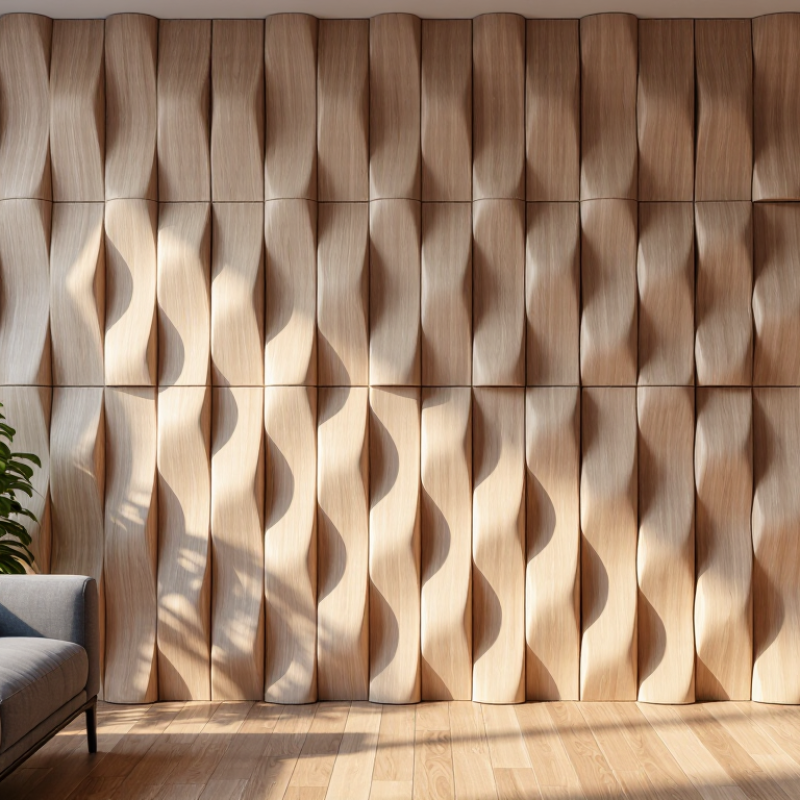
Wave / curved profile About 150–200 mm face width × 20–30 mm projection; lengths vary by product Smooth matte or lightly textured finish Rounded contours soften the appearance and create shifting highlights. Bedrooms, lounges, and walls where a softer 3D pattern is preferred View a sample in the room’s lighting; curved profiles can look different from one angle to another.
Geometric / multi-rib About 150–200 mm face width × 20–35 mm projection; lengths vary by product Matte solid color, fine texture, or decorative wood grain Repeating angular or varied ribs form a more pronounced patterned surface. Compact feature areas, media walls, and modern commercial interiors Check the repeat pattern and joint alignment, especially across multiple panels.
Wood-grain linear profile About 150–200 mm face width × 20–30 mm projection; common lengths include roughly 2.9–3.0 m Embossed grain or printed wood-look surface; matte or low-sheen options Combines linear relief with a timber-inspired appearance. Interiors seeking a warm, natural-looking accent wall Compare sample color and grain direction; printed and embossed finishes may differ in texture.
Low-relief linear profile About 150–200 mm face width × 10–20 mm projection; lengths vary by product Smooth matte, lightly brushed, or subtle embossed finish A restrained 3D effect with less pronounced shadowing. Smaller rooms, narrow spaces, or walls where a discreet texture is desired Check the profile depth and installation method; substrate preparation still matters.

*Dimensions are representative examples. Suppliers may state profile width, overall panel width, net coverage, thickness, and projection differently. Confirm measurements, material specifications, indoor or outdoor suitability, fire-performance documentation where required, and care instructions for the exact product.

Check Durability, Safety, and Maintenance Requirements

When comparing WPC 3D wall panels, inspect more than the raised pattern. Check panel thickness, edge quality, and whether the surface coating looks even. Press a sample gently and examine its corners for cracking or loose layers. These clues cannot predict every failure, but they can reveal poor finishing. Ask for technical data on impact resistance, moisture limits, and expected indoor use. A water-resistant panel is not automatically suitable for a shower area.

Safety needs specific evidence. Review the product’s fire-performance information and emissions documentation, rather than relying on broad words such as “safe” or “eco-friendly.” Follow the installation instructions for clearances around heat sources and for wall preparation. Keep the room ventilated while cutting or fitting panels, and use suitable dust protection. Small details matter. I would still check the documents against the actual panel supplied; product descriptions can be vague.

Maintenance should fit the room. In kitchens, wipe grease promptly with a soft cloth and mild cleaner. In damp spaces, dry standing water and inspect joints for gaps. Avoid abrasive pads, harsh solvents, and unapproved coatings, which may dull or damage the finish. Ask how replacement panels can be matched later. That question is easy to overlook, and I have seen color differences make a small repair more noticeable than expected.

Evaluate Installation Methods, Costs, and Supplier Quality

Installation choices affect both the finish and the labor budget. WPC 3D wall panels may be fixed with adhesive, screws, or a clip system, depending on the panel design and wall condition. Check that the surface is clean, dry, and reasonably flat before ordering. Uneven walls may need battens or extra preparation. Small gaps matter. Follow the panel maker’s expansion guidance, especially near corners and window openings.

Compare the full installed cost, not just the price per panel. Include trims, fasteners, cutting waste, delivery, surface preparation, and labor. Ask contractors to quote the same panel thickness, finish, and installation method; otherwise, the figures may not be comparable. Cheap can become costly. A low unit price may not include the edge profiles needed for a neat finish.

Supplier quality is easier to assess with more than a polished sample. Request a current installation guide, product specifications, and relevant test documents for the intended indoor or outdoor use. Check several panels for consistent color, depth, and edge quality. Ask how damaged pieces and warranty claims are handled. It is easy to overvalue one attractive sample; that can be a mistake. Clear answers and consistent documentation are better signs of dependable supply.