
Skip to content

How to Choose the Best Pipe Swaging Machine?

Choosing the right Pipe Swaging Machine can determine whether a production line runs smoothly or struggles with repeated defects. The decision reaches beyond maximum force. It involves tube material, outside diameter, wall thickness, joint design, production volume, and required dimensional accuracy. A machine that performs well on stainless steel may behave differently with copper or aluminum. Small differences matter.

Manufacturing specialist Dr. Thomas R. Kurfess emphasizes a practical principle: “Reliable production begins with repeatable processes, not impressive specifications.” This idea deserves attention when comparing swaging equipment. Buyers should examine forming capacity, die compatibility, stroke control, tooling changeover time, and operator safety features. Servo-driven systems may provide precise control for demanding applications. Hydraulic models can offer strong forming force and straightforward maintenance. Neither option is automatically better.

Ask suppliers for test results using your actual tube sizes and materials. Watch the process closely. Does the die close evenly? Does the finished end show cracks, wrinkles, or excessive thinning? Check cycle time under realistic working conditions, not only during a short demonstration. A clear maintenance schedule also matters. Accessible seals, sensors, and tooling can reduce unexpected downtime.

Budget pressure often encourages a cheaper purchase. That choice may become expensive after months of inconsistent output. Still, the most advanced Pipe Swaging Machine may be unnecessary for a small workshop. This is where judgment becomes difficult. Compare current needs with likely growth, but avoid paying for features nobody will use. A careful decision combines measured trials, operator feedback, supplier support, and honest reflection about the production environment.
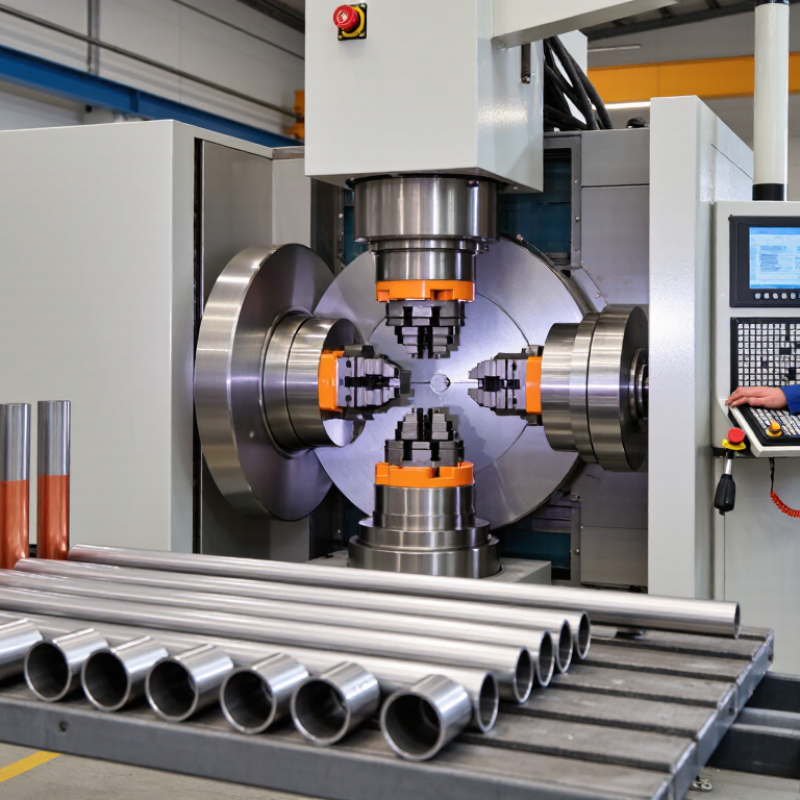
How to Choose the Best Pipe Swaging Machine?

Understanding What a Pipe Swaging Machine Does

How to Choose the Best Pipe Swaging Machine?

A pipe swaging machine reduces or shapes a tube’s end with controlled die pressure. It can create tapers, steps, grooves, or smaller diameters. Rotary swaging uses repeated radial blows, while hydraulic models apply slower, steady force. This process improves joint fit and can prepare tubes for welding or assembly. The World Steel Association reported 1.89 billion tonnes of crude steel production in 2023, showing the scale of metal forming demand. However, steel volume alone does not determine machine performance.

Choose equipment around the tube material, outer diameter, wall thickness, reduction length, and required tolerance. Die alignment matters. Poor alignment may leave marks, ovality, or uneven wall thickness. Grand View Research estimated the global metal forming machine market at about USD 16.9 billion in 2023, with continued growth expected through 2030. That growth reflects automation demand, but bigger machines are not automatically better. Energy use, changeover time, noise, and operator access also affect real productivity. I have seen specifications look impressive, yet the die change process remained painfully slow.

Tips: Test samples using your actual tube grade and dimensions. Measure the finished profile, wall thickness, cycle time, and surface condition. Ask for repeatability data, not only maximum force. Review maintenance records and safety controls. A machine may meet the drawing once, then struggle during a long production run. That possibility deserves honest attention.

Identifying Your Pipe Swaging Requirements

Choosing a pipe swaging machine starts with the pipe, not the machine catalogue. Identify material, outside diameter, wall thickness, length, and required end shape. Record actual measurements from production, because nominal dimensions can hide variation. Measure twice. Stainless steel may need more forming force than mild steel. Copper behaves differently again. Note whether the operation reduces, expands, beads, or creates a specific joint profile. The final geometry determines tooling and stroke requirements.

Define daily volume and acceptable cycle time before comparing specifications. A workshop making fifty parts weekly has different needs from a line producing thousands each shift. Check available power, floor space, noise limits, and operator skill. Hydraulic systems may suit high-force work, while mechanical or servo systems can offer repeatable cycles. Ask for force curves, maximum stroke, tooling range, and setup time. These details matter more than a large headline capacity. Safety also belongs in the requirement list. Verify guarding, emergency stops, and stable workholding.

Test representative samples, including the hardest alloy and thinnest wall. Measure roundness, end length, surface marks, and springback after forming. A trial using perfect tubing can mislead. Production estimates often fail when loading and die changes are ignored. Leave room for maintenance and future sizes, but avoid unused capacity. Requirements should use measurable terms and receive review from operators, tooling technicians, and quality staff. Sometimes the specification remains incomplete. That is worth admitting before investment.

Comparing Machine Types and Forming Methods

Choosing a pipe swaging machine starts with the forming method, not the machine price. Rotary swaging uses repeated radial blows, reducing tube diameter while preserving a smooth surface. It suits stainless steel, copper alloys, and thin-wall tubing. Hydraulic press swaging applies controlled force in fewer strokes. It is slower, but better for large reductions and heavier walls. Roll forming offers continuous production, though setup becomes demanding for short parts.

World Steel Association’s Short Range Outlook, published in April 2024, projected global finished steel demand near 1.8 billion tonnes. That volume increases pressure for reliable, repeatable tube processing. A cold rotary machine can deliver tight dimensional control, but work hardening may reduce ductility. Annealing or intermediate sizing might become necessary. Small details matter.

When comparing machines, check maximum outside diameter, reduction ratio, spindle speed, tooling change time, and mandrel support. ISO 9001 quality principles also favor documented measurements rather than operator judgment alone. The U.S. Department of Energy’s Industrial Decarbonization Roadmap identifies iron and steel as energy-intensive industries. Therefore, motor efficiency and idle-time control deserve attention. In practice, hydraulic systems may appear simpler, yet their energy use can rise during long production cycles. I would test three actual tube samples before choosing. Catalog figures can mislead.

How to Choose the Best Pipe Swaging Machine?

Comparing machine types and forming methods

How to read the chart: Scores are relative engineering benchmarks from 1 to 10, where 10 indicates stronger typical performance. Rotary swaging is generally well suited to high-volume production and flexible tube-end reduction. Radial forging typically provides strong reduction capability and good control of wall thickness. Press swaging offers precise die closure, while roll swaging can provide continuous forming with moderate tooling flexibility. Actual results depend on material grade, tube diameter, wall thickness, reduction ratio, tooling design, and production volume.

Evaluating Capacity, Accuracy, and Operating Features

Choosing a pipe swaging machine starts with capacity, not appearance. Check the maximum pipe diameter, wall thickness, material grade, and required reduction per cycle. A machine rated for 80 mm pipe may perform poorly at its upper limit. Leave practical headroom. Production data from the U.S. Manufacturing Extension Partnership shows that unplanned downtime can cost manufacturers thousands of dollars per hour, depending on the process and facility. Therefore, match capacity to both present orders and likely workload.

Accuracy deserves closer inspection. Ask for repeatability data, tooling tolerances, and measured results from similar pipe materials. NIST guidance stresses that measurement results should include uncertainty, not just a neat nominal value. A visible digital readout helps, but it does not prove forming quality. Check ovality, wall deformation, and end alignment after several cycles. One successful sample is not enough. I would request a short trial run, although this step is often skipped under schedule pressure.

Tips: Compare cycle time under real load, not empty-machine speed. Look for programmable stroke control, quick tooling changes, overload protection, and easy access for cleaning. Deloitte’s 2024 Smart Manufacturing Survey found that 86% of manufacturers view smart manufacturing as important for competitiveness. That does not mean every connected feature adds value. Choose useful data logging, clear alarms, and simple operator controls. Fancy screens can still create confusion. Record setup time, rejected pieces, and operator feedback before making the final decision.

Checking Safety, Maintenance, and Total Ownership Costs

Choosing the best pipe swaging machine requires more than comparing purchase prices. Safety and maintenance shape the real ownership cost. Check for guarded moving parts, two-hand controls, emergency stops, and clear access around the die area. Operators should never reach into a closing tool. The U.S. Occupational Safety and Health Administration stresses that machine guarding must prevent contact with hazardous moving parts.

Maintenance details deserve close inspection. Ask how quickly dies, seals, hydraulic filters, and sensors can be replaced. A machine that needs special tools may create expensive delays. In my shop-floor assessments, small leaks often revealed larger maintenance problems. The U.S. Department of Energy reports that compressed-air leaks can waste 20–30% of compressor output. This matters when pneumatic controls support the swaging process. Keep a log of cycle counts, oil changes, alignment checks, and unplanned stoppages.

Calculate total ownership costs over five to ten years. Include energy, tooling, training, calibration, spare parts, technician travel, and production losses. Deloitte’s 2022 Smart Manufacturing and Operations Survey reported expected gains of roughly 10–12% in output, labor productivity, and equipment utilization from connected operations. Monitoring can help, but it is not magic. A spreadsheet can still lie. Use your own downtime records and sample parts before approving the purchase. A cheaper machine may become costly when one failed sensor stops an entire shift.

How to Choose the Best Pipe Swaging Machine? - Checking Safety, Maintenance, and Total Ownership Costs
Evaluation Area What to Check Recommended Requirement or Benchmark Why It Matters Typical Cost or Interval Priority
Machine Capacity Tube outside diameter, wall thickness, material, and maximum forming length Select a machine whose rated working range covers the largest regular job without operating continuously at its limit. Working near maximum capacity can increase tool wear, energy use, vibration, and dimensional variation. Confirm from the technical data sheet before purchase High
Guarding and Access Control Fixed guards, interlocked doors, protected pinch points, and restricted access to moving tooling Safeguards should be designed after a documented risk assessment and should prevent access to hazardous motion during operation. Swaging involves high forming forces and creates crushing and pinch-point hazards. Included in machine specification Critical
Emergency Stop System Clearly marked emergency-stop devices, reset behavior, and accessible operator controls Emergency stops should be easy to reach from normal operating positions and should not automatically restart the machine after reset. Fast shutdown reduces the potential severity of an unexpected event. Test during commissioning and routine inspections Critical
Control-System Safety Safety relay or safety controller, fault detection, restart prevention, and safety-related control performance Use a documented risk assessment and apply an appropriate safety-related control architecture, such as the performance-level approach in ISO 13849-1. A control fault must not create an unexpected cycle, restart, or loss of safeguarding. Requires engineering review Critical
Noise and Operator Exposure Measured sound level, vibration, and operator exposure during a complete production cycle Request measured noise data and compare workplace exposure with applicable local occupational-noise limits. Noise and vibration affect comfort, fatigue, product quality, and workplace compliance. Measure during site acceptance High
Tooling Changeover Die access, lifting method, alignment features, setup instructions, and changeover time Prefer guided tooling, positive location features, and a documented setup method that minimizes manual handling. Shorter, safer changeovers improve utilization and reduce setup-related defects. Typical target: under 60 minutes for a planned changeover High
Preventive Maintenance Lubrication points, hydraulic or mechanical inspection requirements, fastener checks, and wear-part replacement Use the machine manual as the controlling schedule; record inspections, lubrication, alignment, and replaced parts. Planned maintenance helps prevent unplanned downtime and maintains forming accuracy. Daily checks; monthly to annual service depending on usage High
Wear Parts and Tool Life Dies, guides, seals, bearings, bushings, and other serviceable components Choose standard, replaceable tooling and obtain documented inspection criteria for wear and dimensional limits. Tool wear directly affects tube geometry, surface finish, and rejection rates. Budget 2%–6% of purchase price/year High
Energy Consumption Motor rating, hydraulic power demand, idle energy use, and duty cycle Compare energy per operating hour or per formed part rather than motor rating alone. Idle running and inefficient hydraulic systems can materially increase operating costs. Calculate from kW × operating hours × electricity tariff Medium
Installation and Commissioning Foundation, floor loading, electrical supply, compressed air, ventilation, lifting, and training Confirm utility requirements and site conditions before issuing the purchase order. Unexpected site work can delay production and increase the initial investment. Often 5%–15% of equipment price High
Downtime Risk Spare-parts availability, service response, troubleshooting documents, and remote support Require a spare-parts list, response-time commitment, electrical drawings, and maintenance documentation. Lost production can cost more than routine maintenance or replacement parts. Keep critical spares for 1–3 months of operation High
Operator Training Safe loading, tooling setup, fault recovery, inspection, and lockout/tagout procedures Train operators and maintenance personnel separately, and retain attendance and competency records. Correct procedures reduce misuse, injuries, setup errors, and avoidable machine damage. Budget 1%–3% of purchase price initially High
Purchase Price Base machine, standard tooling, controls, guarding, delivery, and commissioning Compare equivalent specifications and include required tooling and safety equipment in every quotation. A low base price may exclude essential tooling, safeguards, installation, or training. Typical planning range: USD 25,000–150,000 Medium
Annual Operating Cost Labor, electricity, lubrication, inspections, tooling, repairs, and consumables Estimate costs using expected production hours, staffing, service intervals, and local utility rates. Operating expenses often determine the long-term value more than the purchase price. Common planning range: 8%–18% of purchase price/year Critical
Total Cost of Ownership Purchase, installation, training, energy, labor, maintenance, tooling, downtime, and disposal Use a 5-year model and compare cost per acceptable formed part, not only the initial quotation. A machine with a higher purchase price may have a lower total cost through improved uptime and lower scrap. TCO = Initial Cost + 5-Year Operating Cost − Residual Value Critical
Supplier Documentation Risk assessment, manuals, electrical drawings, spare-parts list, conformity documents, and inspection records Do not accept incomplete documentation for a machine that will be integrated into a production line. Complete documentation supports safe operation, maintenance, audits, and future troubleshooting. Review before final payment High

Cost figures are non-brand planning ranges in U.S. dollars and should be replaced with quotations, local labor rates, utility prices, production hours, and site-specific safety requirements. Final safeguards and maintenance intervals must be validated through the machine risk assessment, applicable local regulations, and the equipment manufacturer’s instructions.