
How to Choose PP Geogrid for Global Projects?
Choosing Pp Geogrid for global projects requires more than comparing price, tensile strength, or shipment availability. Site conditions change dramatically between a coastal embankment, a desert haul road, and a rain-soaked railway foundation. Soil type, aggregate quality, drainage, installation equipment, and design life must guide the decision. Small details matter. A damaged roll can compromise an entire working area.
The Federal Highway Administration’s geosynthetic guidance emphasizes site investigation, material characterization, connection performance, and construction quality control. ASTM D6637 and ISO 10319 also provide recognized methods for measuring tensile properties. Meanwhile, the Research and Markets Geogrids Global Market Report 2024 identifies transportation infrastructure, retaining structures, and soil stabilization as major application areas. These reports support a practical lesson: laboratory strength alone cannot predict field performance.
Dr. Jorge G. Zornberg, a leading geosynthetics researcher, has described geosynthetics as “an integral part of modern infrastructure.” His observation remains useful, although it does not answer every project question. Designers must still examine junction strength, aperture geometry, creep resistance, UV exposure, and chemical compatibility. Product selection can be imperfect.
That is acceptable when assumptions are documented and tested.
This guide explains how to compare Pp Geogrid products across climates, standards, suppliers, and construction practices. It focuses on evidence rather than marketing claims. Readers should verify technical data with the manufacturer, independent testing, and local engineering requirements before specifying a product.
What Is PP Geogrid and Why Is It Used in Global Projects?
PP geogrid is a polymer reinforcement material made from polypropylene. Its open, grid-like structure interacts with surrounding soil particles. During construction, aggregate enters the apertures and creates mechanical interlock. This helps distribute loads across weak or variable ground. Unlike ordinary plastic sheets, PP geogrid is designed to reinforce soil, not simply separate materials.
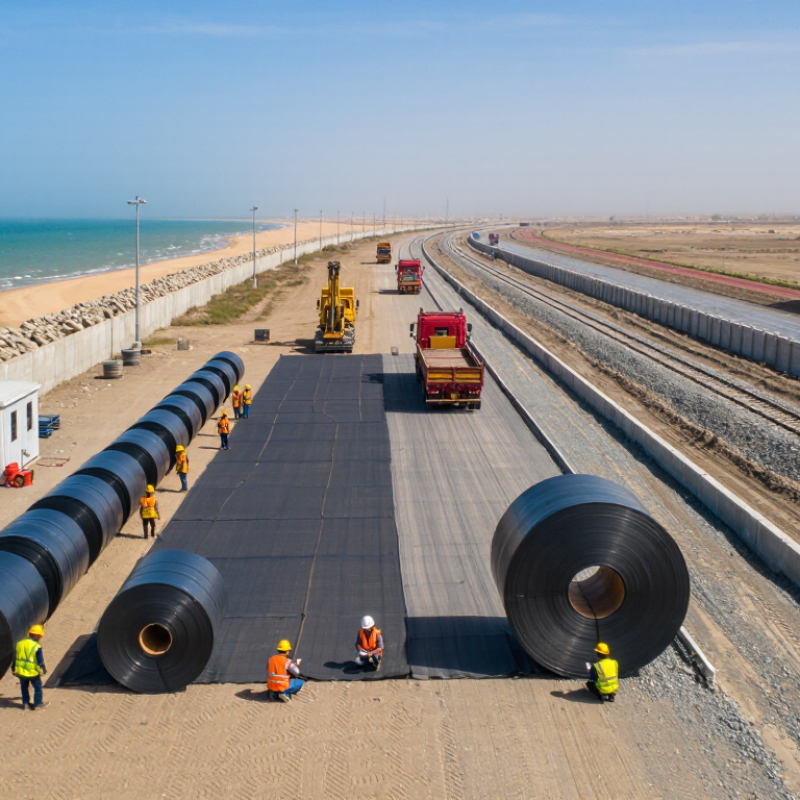
Global projects use PP geogrid beneath roads, railways, parking areas, embankments, and working platforms. It can reduce rutting, limit lateral aggregate movement, and improve performance over soft subgrades. Its low water absorption is useful in wet climates. Its chemical resistance also supports applications near many soils and construction materials. Field engineers still need to check temperature, ultraviolet exposure, installation damage, and long-term loading.
A practical selection begins with the soil report, not the product label. Designers should review aperture shape, tensile strength, junction performance, stiffness, and required service life. Local drainage matters too. A strong grid cannot correct poor water management. On site, sharp aggregate and careless equipment movement may damage the material. That detail is easy to underestimate. No selection is perfect. Calculations can miss seasonal freezing, unexpected fill, or uneven compaction. Trial sections and documented installation checks often reveal these weaknesses before full construction begins.
How to Choose PP Geogrid for Global Projects? - What Is PP Geogrid and Why Is It Used in Global Projects?
| Selection Dimension | Typical PP Geogrid Data | Why It Matters in Global Projects | Practical Selection Guidance | Common Reference Method |
|---|---|---|---|---|
| Material composition | Polypropylene (PP), a chemically resistant thermoplastic polymer | Supports use in soils exposed to moisture, salts, acids, and many alkaline environments | Confirm compatibility with the actual soil, fill material, drainage conditions, and contaminants | Project-specific durability assessment |
| Geogrid structure | Biaxial or uniaxial; extruded, punched, and stretched sheet construction is common | The structure determines load direction, soil interlock, and reinforcement efficiency | Choose biaxial grids for multidirectional base reinforcement; choose uniaxial grids for predominantly one-directional loads such as retaining walls and slopes | ISO 10318 terminology; manufacturer construction data |
| Ultimate tensile strength | Common commercial range: approximately 20–200 kN/m, depending on direction and product class | Indicates the maximum tensile resistance before rupture, but does not alone define design capacity | Select the required strength from calculated tensile demand, installation damage, creep, temperature, and durability factors | ASTM D6637 or ISO 10319 |
| Tensile strength at design strain | Often reported at 2%, 5%, and 10% strain; project values vary by product | Service performance is usually governed by the strength available at allowable strain rather than ultimate strength | Compare products using the same test method, strain level, loading direction, and temperature | ASTM D6637 or ISO 10319 |
| Elongation at break | Typically about 8–15% for many rigid PP geogrid products; values vary by orientation and construction | Lower elongation generally helps mobilize reinforcement sooner and control deformation | Use the actual stress–strain curve for settlement-sensitive roads, platforms, and reinforced walls | ASTM D6637 or ISO 10319 |
| Aperture size | Common nominal aperture dimensions are approximately 20–40 mm, subject to product geometry | Apertures allow aggregate or soil particles to interlock with the ribs | Match aperture size and rib geometry to the selected fill gradation; avoid excessive aperture size relative to the aggregate | Product technical data; ISO 10318 terminology |
| Junction efficiency | Often specified at 90% or higher for high-quality integral geogrid designs; verify the certified value | Strong junctions help maintain load transfer where longitudinal and transverse ribs intersect | Request junction-strength results and test conditions, especially for heavy-duty pavements and working platforms | Manufacturer or project-specified junction test |
| Creep and long-term design | PP is viscoelastic; long-term strength must be reduced using creep and durability factors | Long-term tensile capacity can be lower than short-term laboratory strength under sustained load | Use project-approved reduction factors supported by long-term test data and the intended design life | ASTM D5262; ISO/TR 20432 |
| Installation damage resistance | Performance depends on rib thickness, junction design, aggregate angularity, compaction equipment, and cover thickness | Construction damage may reduce tensile capacity before the geogrid enters service | Require site-representative testing when using sharp crushed stone, heavy rollers, or difficult access conditions | ASTM D5818 or equivalent project procedure |
| Chemical and biological resistance | Generally resistant to many acids, alkalis, salts, and biological agents encountered in soil | Useful for road bases, foundations, mining areas, ports, and drainage-related applications | Check exposure to hydrocarbons, oxidizing chemicals, unusual industrial waste, and high-temperature fluids | Project-specific chemical compatibility testing |
| UV exposure and storage | PP can degrade under prolonged ultraviolet exposure; covered storage and timely installation are required | Global projects may involve intense sunlight, long transport routes, or extended site storage | Confirm UV-stability data and follow the specified maximum exposure period before cover placement | ASTM D4355 or equivalent UV-exposure procedure |
| Temperature considerations | PP softens at elevated temperatures; short-term and long-term properties are temperature-dependent | Relevant for hot climates, paved areas, industrial yards, and locations with large seasonal temperature changes | Use temperature-adjusted reduction factors and verify performance at the project design temperature | ISO 10319; project-specific temperature testing |
| Typical reinforced applications | Road-base reinforcement, railway subgrades, working platforms, retaining walls, reinforced slopes, and embankments | Improves aggregate confinement, distributes wheel loads, and can reduce rutting or required fill thickness | Define the failure mode first: bearing capacity, lateral spreading, rutting, pullout, or slope stability | Design code and project geotechnical report |
| Installation requirements | Install flat or wrinkle-free, provide adequate overlap or connection, place approved fill, and compact without exposing the grid | Correct installation is essential for soil interlock and for achieving the assumed design performance | Prepare an installation method statement covering subgrade condition, overlap, fill placement, equipment, and inspection | Project specifications; ASTM D4883 where applicable |
| Documentation for international procurement | Product datasheet, test reports, quality certificates, roll dimensions, batch traceability, packaging details, and installation instructions | Consistent documentation supports technical approval, customs clearance, quality control, and comparison across countries | Require test results using consistent units, directions, standards, and acceptance criteria before purchase | Applicable national standard, project specification, ISO 9001 quality system evidence |