
Choosing a Pvdf Air Dome in 2026 means evaluating more than a smooth, white roof. The membrane, anchoring system, airlocks, fans, and backup power must work as one structure. The 2024 Global Status Report for Buildings and Construction, published by UNEP and the Global Alliance for Buildings and Construction, estimates that buildings account for 32% of global energy demand and 34% of energy-related carbon dioxide emissions. Those figures are not dome-specific, but they make operating energy worth checking. Ask suppliers for measured fan consumption, insulation data, and clear assumptions about occupancy and climate. Numbers need context.
Start with the site. Local wind, snow, rainfall, temperature swings, and ground conditions shape the design load. Then inspect the fabric specification: base-fabric strength, PVDF coating, seam performance, UV resistance, and documented fire-test results. Request independent test reports, not just a brochure claim. Review the anchoring details and emergency procedures, too. A strong membrane cannot compensate for weak site preparation.
There is no universal best dome. A sports facility with daily use may need different ventilation and access than a seasonal storage space. Compare warranty terms, inspection intervals, spare-part availability, and the supplier’s record on similar projects. Ask what happens during a power interruption. That detail is easy to overlook. One honest limitation: quoted service life depends on exposure, maintenance, and installation quality. Treat it as an estimate, not a promise.
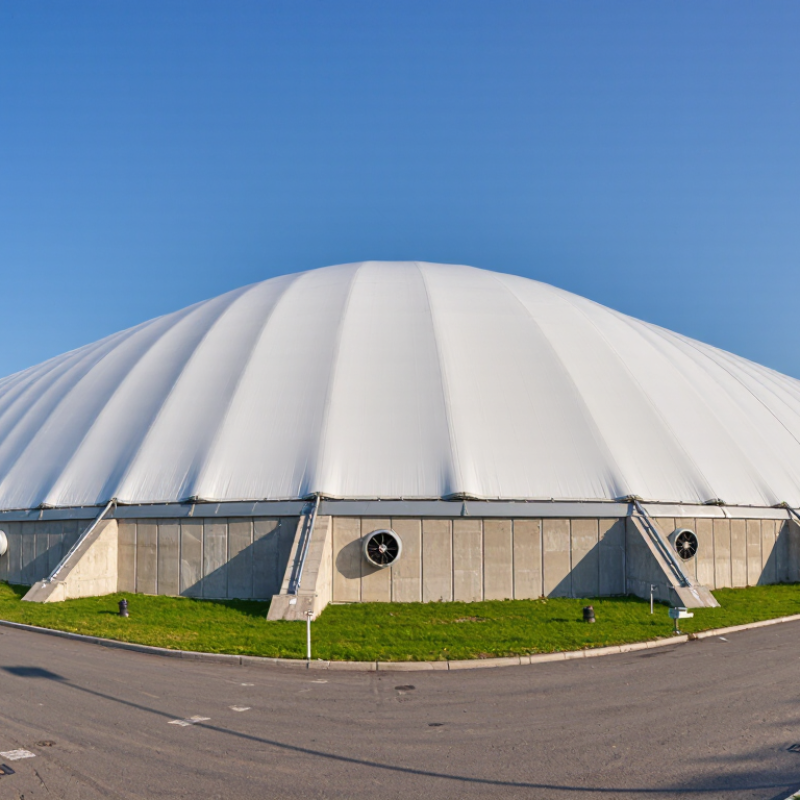
Before selecting a PVDF air dome, define what happens inside it. A training hall needs clear sightlines, safe overhead clearance, and space for equipment. A storage dome may need wide vehicle access and protection from condensation. List the required floor area, peak occupancy, operating hours, ventilation needs, and acceptable downtime. Small details matter. A delivery truck’s turning path can shape the entrance layout. So can the location of lights and fans. A frequent planning blind spot is specifying the dome by area alone; revisit that assumption before requesting quotations.
Then check the actual site. Record prevailing winds, snowfall, rainfall, drainage, soil conditions, and access to reliable power for inflation fans. ASCE/SEI 7-22 provides design criteria for wind, snow, and other structural loads; a qualified engineer should apply the relevant local values. NOAA’s 1991–2020 U.S. Climate Normals provide 30-year temperature and precipitation baselines, but averages do not replace site-specific design extremes. The World Meteorological Organization reported that 2024 was about 1.55°C warmer than the 1850–1900 average, a reminder that historical climate patterns can shift. This figure is global, not a local load value. Request a site assessment, and confirm backup power, emergency access, and maintenance clearance before fixing the dome’s size or orientation. A rushed site survey is easy to regret.
PVDF air-dome fabric is usually layered: a woven polyester base carries a polymer coating, often with a PVDF outer finish. The base provides much of the tensile and tear strength, while coatings help resist moisture, dirt, and weathering. Not just thickness. Compare coating chemistry, adhesion, and flexibility after cold exposure, not only coating weight. A thicker layer may add mass without improving durability if it cracks or peels. Ask for documented abrasion, weathering, and seam-weld test results, including the test methods and sample conditions.
Performance sheets should list tensile strength in both fabric directions, tear strength, seam strength, air permeability, and the operating temperature range. Check whether reported values describe new material or aged samples. Numbers need context. For an air dome, membrane ratings should also suit the engineer’s design loads for wind, snow, internal pressure, and span. Request batch traceability and inspection records, then look for coating uniformity, pinholes, and clean, consistent welds. Lab results cannot capture every installation detail; anchoring, repairs, and maintenance also affect service life. I would not choose from one headline strength figure. It is convenient, but incomplete.
Typical service-life planning ranges for selected architectural membrane systems
These broad planning ranges are not guaranteed product lifetimes. UV exposure, climate, fabrication, maintenance, and project design affect actual performance. PTFE-coated fiberglass is a comparison benchmark, not a direct substitute for a typical air-dome membrane. Before selecting a PVDF-coated fabric, verify its tensile and tear strength, coating adhesion, seam strength, fire performance, and project-specific wind and snow ratings from test reports.
Choosing a PVDF air dome means checking the structure, not just the coated fabric. Request calculations for wind, snow, rain, and internal pressure at the actual site. ASCE/SEI 7-22 provides hazard-mapping procedures for these loads; the governing values depend on location, exposure, and building geometry. Ask for the design pressure, anchor layout, seam-strength results, and a clear inspection schedule. Look closely at the perimeter: anchors set into weak or unverified ground can undermine an otherwise sound design. Small detail. Important consequence.
Climate history is useful, but it cannot replace site-specific engineering. NOAA’s 2023 Billion-Dollar Weather and Climate Disasters report recorded 28 U.S. events with losses of at least $1 billion, totaling about $92.9 billion. That figure is not an air-dome load value; it is a reminder to assess hazards beyond average weather. Check the locally adopted building code and permit requirements. The 2024 International Building Code addresses membrane structures in Chapter 31, Section 3102, but local editions and amendments may differ. Confirm requirements for exits, fire protection, emergency power, and pressure monitoring with the building official. I would not accept a generic “code compliant” claim without calculations and documents tied to the project’s location. Some paperwork feels excessive until the first severe storm.
| Assessment area | What to check | Evidence to request | Selection guidance |
|---|---|---|---|
| Membrane construction | Confirm the membrane is a coated architectural fabric, commonly woven polyester with a PVDF-based surface coating. Check fabric weight, tensile and tear properties, coating details, seam construction, and compatibility with the intended exposure. | Project-specific material data sheets and test reports identifying the tested fabric, test method, direction of loading, and results. Ask how seams and field repairs are addressed. | Compare tested properties and warranties on the same basis. Do not treat “PVDF” alone as a complete membrane specification. |
| Structural design | Review the dome geometry, cable or reinforcement layout, anchorage, edge details, openings, and the interaction between membrane tension and internal air pressure. | Sealed, project-specific calculations and drawings prepared by a qualified structural engineer; include load combinations, support reactions, connection details, and assumptions. | Require calculations for the actual site, dimensions, use, and openings—not only a standard or previous-project design. |
| Wind loads | Wind demand depends on location, exposure, building geometry, height, surrounding terrain, and applicable code parameters. Check pressure zones, uplift, lateral forces, and anchorage. | Site-specific wind-load basis and structural calculations. In the United States, confirm the applicable edition of ASCE/SEI 7 as adopted by the local jurisdiction. | Do not select a dome using a generic wind-speed claim without confirming the code basis, site conditions, and design pressures. |
| Snow and ice | Evaluate local ground snow load and the effects of roof shape, drifting, unbalanced snow, rain-on-snow where applicable, and ice accumulation. Account for the dome’s operating and deflation conditions. | Project-specific snow-load calculations, operating procedures for severe weather, and written criteria for snow monitoring and response. | Snow capacity is site- and design-specific. Confirm how the design addresses unusual accumulation and what actions the operator must take. |
| Internal pressure and air systems | Check the engineered operating-pressure range, control set points, pressure monitoring, backup power, redundancy, and response to a blower or power failure. | Air-system design documents, control sequence, alarm description, backup-power details, and commissioning and maintenance procedures. | Require documented performance for normal operation and credible failure scenarios. Pressure settings should be established by the project’s engineering design. |
| Emergency egress | Review exit number, location, width, hardware, travel distances, emergency lighting, accessible routes, and the effect of pressure loss on doors and evacuation. | Life-safety plans and review by the authority having jurisdiction (AHJ), with evacuation and emergency-operation procedures. | Confirm that occupants can exit safely during both normal operation and the emergency conditions identified in the approved design. |
| Fire and life safety | Check the required membrane fire-test classification, interior finishes, fire detection and alarm provisions, and any required suppression or fire-service access. | Test reports for the specified membrane assembly and written confirmation of the applicable local fire-code requirements. In the United States, NFPA 701 may be relevant to certain textile materials, but applicability depends on the code and use. | Do not assume one fabric fire test satisfies every building or fire code. Obtain acceptance from the AHJ for the proposed assembly and occupancy. |
| Building-code compliance | Identify the adopted building-code edition, occupancy classification, permits, structural provisions for air-supported structures, fire requirements, accessibility, and local amendments. | Code analysis and permit documents prepared for the project. In the United States, the adopted International Building Code may include provisions for membrane structures; the locally adopted edition and amendments govern. | Confirm requirements with the AHJ before final design or purchase. Code adoption and approval requirements vary by jurisdiction. |
| Anchorage and foundations | Check soil conditions, foundation design, anchor layout, edge restraints, corrosion exposure, drainage, and the load path from membrane to ground. | Geotechnical information where required, foundation and anchorage calculations, connection drawings, and inspection requirements. | Verify that the complete load path is designed for the project loads; membrane calculations alone are not sufficient. |
| Operations and maintenance | Assess inspection frequency, membrane cleaning and repair, air-system servicing, sensor calibration, spare parts, staff training, and severe-weather procedures. | Operations and maintenance manual, inspection checklist, repair instructions, training plan, and commissioning records. | Choose a design that the owner can inspect and maintain reliably throughout its intended service life. |
| Final project review | Compare the complete engineered scope, exclusions, design criteria, approval status, maintenance needs, and lifecycle responsibilities. | Coordinated drawings, calculations, material documentation, code review comments, commissioning plan, and a written list of assumptions and exclusions. | Proceed only after site-specific engineering and required authority reviews are complete. |
Important: Loads, material performance, fire-test requirements, and code provisions are project- and jurisdiction-specific. Use the code editions adopted by the local authority and have the final design reviewed by qualified professionals.
Choosing a PVDF air dome in 2026 means judging the operating system, not just the fabric. Most air-supported structures rely on continuously running fans to maintain pressure, while an airlock or revolving entrance limits pressure loss. Ask for normal and peak airflow figures, standby arrangements, alarm response, and generator connections. A fan failure should not become an avoidable scramble. Check noise levels, too, especially near homes or work areas.
Estimate energy use from local wind, snow, temperature, occupancy, and opening frequency; brochure averages can hide winter peaks. Request a seasonal load estimate covering heating, ventilation, dehumidification, and backup operation. Compare it with utility rates and planned operating hours. Small leaks matter. Door seals, filter condition, and fan settings can shift consumption over time. If the estimate assumes perfect habits, treat it cautiously; people may prop doors open.
Maintenance should be specific and scheduled. Inspect seams, cable attachments, anchors, drainage, and membrane surfaces after severe weather and at routine intervals. Confirm access to replacement parts and expected technical support response times. Ask how repairs affect warranties and whether inspection records are provided. PVDF-coated fabric may resist weathering, but coatings, welds, and structural components age differently. Service life is not one number. Compare documented inspection history and repair assumptions rather than relying on a lifespan claim alone.
Choosing a PVDF air dome in 2026 starts with comparing complete proposals, not headline prices. Ask each supplier for membrane specifications, design loads, operating-pressure assumptions, and project references with similar climates and spans. Request a clear list of included equipment, too. One quote may include controls and commissioning; another may not. That difference matters.
Read warranty terms alongside the installation plan. Check coverage periods for the membrane, seams, blowers, and control systems, plus exclusions for maintenance or extreme weather. Ask who handles site preparation, anchoring, delivery, assembly, and final testing. Details matter. A schedule should identify crew size, access needs, weather delays, and who resolves problems between contractors. Vague handoffs can become expensive.
Compare total project costs over the dome’s expected service life. Include foundations, shipping, electrical work, ventilation, permits, routine inspections, energy use, and likely component replacement. Ask suppliers to state assumptions, such as local power rates and planned operating hours, so bids can be compared fairly. Look beyond price. Keep a contingency for site conditions; even a careful estimate can miss drainage work or difficult access.
