
What Are the Best PVC Marble Wall Panels in 2026?
Choosing the best Pvc Marble Wall Panels in 2026 means looking beyond a glossy product photo. A panel may resemble veined stone online, yet its finish, thickness, edge detail, and color can look different in person. Even the lighting in a small bathroom can change how those veins appear.
This guide compares the details that matter during real projects: surface appearance, panel dimensions, installation requirements, cleaning guidance, and the manufacturer’s product information. A sample held beside a vanity or shower can reveal more than a screen image. Check how joints align, whether trims are available, and what the supplier says about suitable locations. Do not assume every panel is appropriate for every wet area; confirm its specifications and follow installation instructions.
There is no single best choice for every room. Some homeowners may prioritize a bright marble pattern, while others need easier handling or fewer visible seams. Budget matters, too, but the lowest price may not reflect the full cost of trims, preparation, and fitting. Small details count. This overview will help you compare options carefully and identify questions to ask before buying. Product ranges and specifications can change, so verify current details with the manufacturer or retailer. And be realistic: a printed finish may look convincing from across the room, but close inspection can reveal repeating patterns or joins. That is worth considering.
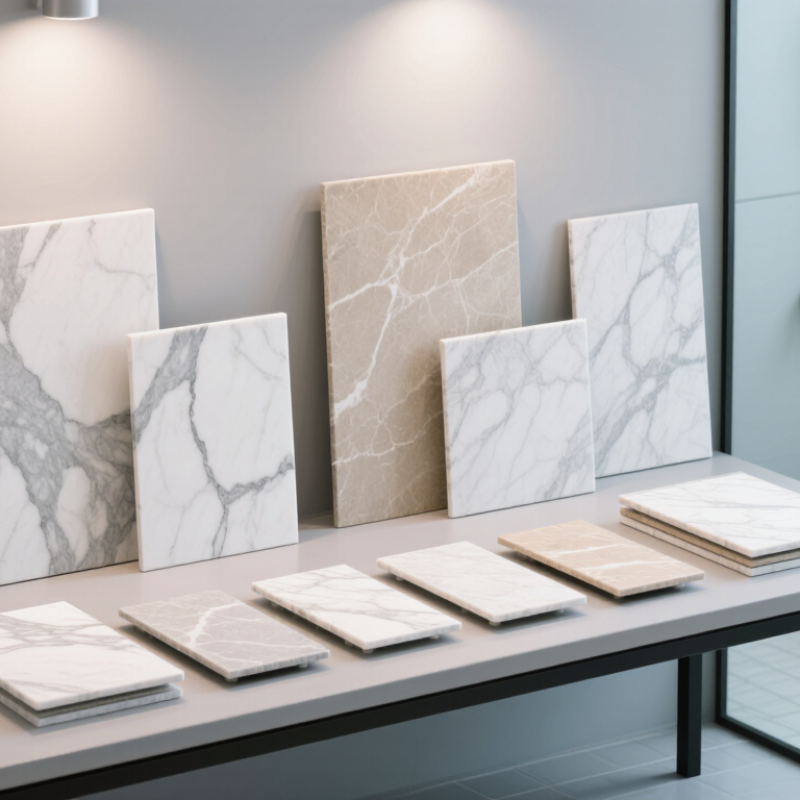
What PVC Marble Wall Panels Are and How They Are Made
PVC marble wall panels are decorative sheets designed to resemble polished stone without the weight of solid marble. Most use a rigid PVC-based core, a printed film that carries the veining, and a clear surface layer for protection. They are commonly used on interior walls, including bathrooms, but performance depends on the panel and how it is installed.
Not stone. In typical manufacturing, PVC resin is blended with stabilizers, pigments, and mineral fillers, then shaped into sheets through extrusion or a similar forming process. A marble pattern is printed onto a film or applied as a decorative layer. Heat and pressure bond the layers; a protective coating may then improve resistance to scratches and stains. Details matter. Uneven color, weak bonding, or a thin wear layer can affect appearance and service life, so inspect a sample in natural light and check its edges.
A smooth panel may resist splashes, yet seams, cutouts, and wall surfaces still need careful sealing and preparation. Don’t assume every product suits a shower or high-heat area; follow its installation guidance. I’ve seen a convincing pattern look less natural when repeated across a large wall. Ask about thickness, surface finish, and cleaning requirements before choosing. Small samples can be misleading.
What Are the Best PVC Marble Wall Panels in 2026? — What PVC Marble Wall Panels Are and How They Are Made
| Data Dimension | Typical Details | What to Check When Choosing |
|---|---|---|
| What the panels are | Decorative wall sheets made mainly from polyvinyl chloride (PVC), often combined with mineral fillers and surface layers printed with a marble design. | Confirm the panel’s full construction and intended interior or exterior use; “marble” describes the appearance, not natural stone content. |
| Typical layer structure | A panel may include a PVC-based core, a printed decorative film, and a clear protective coating. Exact layer count and materials vary by product. | Ask whether the surface has a protective finish and whether the panel edges and joints are designed for the intended installation area. |
| Core materials | PVC resin is commonly blended with additives; calcium carbonate or other mineral fillers may be used to modify cost, stiffness, weight, or processing characteristics. | Compare stated composition and product documentation rather than judging quality by color or appearance alone. |
| How they are made | PVC compounds are commonly processed into sheets by extrusion or related forming methods. Decorative films may then be printed or laminated onto the surface, followed by a protective finish when specified. | Manufacturing steps differ. Check technical information for surface finish, core structure, and any relevant test results. |
| Common formats | Panels are sold in different sheet and plank sizes. Dimensions and thicknesses are not standardized across all products; thinner sheets and thicker rigid panels are both available. | Verify actual sheet dimensions, thickness, usable coverage, and trim requirements before estimating quantities. |
| Water and moisture use | PVC itself does not absorb water like many porous materials, but the performance of a finished wall depends on seams, edges, penetrations, adhesive, and the condition of the substrate. | For wet areas, follow the installation instructions and seal joints as specified. Do not assume that every panel system is a waterproofing membrane. |
| Weight and installation | PVC panels are generally lighter than natural stone slabs. Depending on the system, they may be bonded to a suitable substrate or installed with profiles and mechanical fixing. | Check substrate flatness, adhesive compatibility, fixing method, expansion allowances, and the manufacturer’s installation instructions. |
| Appearance and pattern | Marble effects are printed or laminated designs. Pattern scale, gloss level, color, and variation between sheets depend on the decorative film and production run. | View multiple sheets or a full-size sample to assess pattern repeats, color consistency, and how joints will look on the finished wall. |
| Cleaning and maintenance | Many finished PVC surfaces can be cleaned with a soft cloth and mild detergent, but abrasive pads and harsh chemicals may damage the decorative coating. | Use the care instructions for the specific finish and test any cleaning product in an inconspicuous area first. |
| Fire and indoor-air documentation | Fire behavior and emissions depend on the product formulation and construction. Results for one panel cannot be assumed to apply to another. | Request applicable test reports or declarations and check local building requirements, especially for public or high-occupancy spaces. |
| Best-fit selection | A suitable panel balances intended location, core rigidity, finish durability, available dimensions, installation method, and documented performance. | There is no single best panel for every project. Compare technical specifications and installation requirements for the exact application. |
Note: Panel construction, dimensions, finishes, and performance vary by product. Use the product’s current technical documentation for project-specific decisions.