
Skip to content

China Best Corrugated Steel Pipe Manufacturers?

China’s steelmaking scale makes it a significant place to search for Corrugated Steel Pipe suppliers. World Steel Association data report that China produced 1,005.1 million tonnes of crude steel in 2024, out of 1,882.6 million tonnes worldwide. That is useful context, not proof of pipe quality. Steel output alone cannot identify the best manufacturer.

A credible comparison should examine more than price and catalogue photographs. Buyers can request mill certificates, coating specifications, dimensional tolerances, and documented inspection procedures. They should also verify whether a factory produces the required pipe profiles, diameters, and fittings in-house. Small details matter: a coating-thickness record or a clearly marked pipe section can reveal how carefully quality is controlled. Ask for recent project references, too.

Design requirements deserve equal attention. The Federal Highway Administration’s Hydraulic Design of Highway Culverts (HDS-5) provides technical guidance for culvert design, including hydraulic considerations. It does not rank Chinese manufacturers, and no single supplier suits every project. That distinction is easy to miss. This guide therefore treats “best” as a practical match between engineering needs, manufacturing evidence, delivery capability, and after-sales support—not a universal label. Some information may remain difficult to verify from public listings, so direct checks are necessary.
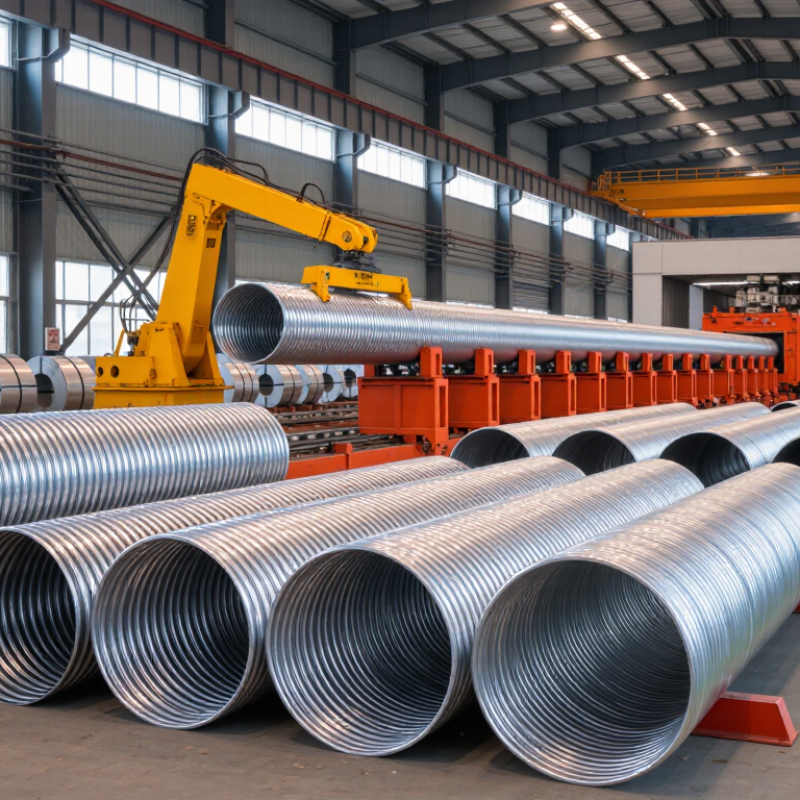
China Best Corrugated Steel Pipe Manufacturers?

What Defines Corrugated Steel Pipe and Its Core Infrastructure Uses?

Corrugated steel pipe is formed from steel sheet shaped into repeated ridges and valleys. These corrugations add stiffness, helping the pipe resist soil pressure while remaining relatively light to transport and install. It is not simply a smooth metal tube with a rough surface. The profile and steel thickness both affect its structural behavior.

Its core infrastructure uses include road culverts, stormwater drainage, and cross-drains beneath railways or access routes. A culvert may carry runoff under a road embankment, where blocked flow can cause standing water or erosion at the outlet. Corrugated steel pipe is also used to protect utility lines in some projects. The right application depends on flow, soil conditions, burial depth, and expected loads.

Details matter. Engineers and installers consider pipe diameter, corrugation shape, protective coating, joint design, and the quality of bedding and backfill. Poor compaction can create uneven support around the pipe. A product can look robust and still be a poor match for a corrosive site or heavy traffic. That part deserves careful review. Soil chemistry, abrasion from sediment, and maintenance access may influence service life, so project specifications should be checked against actual site conditions rather than assumptions.

Corrugated Steel Pipe: Core Infrastructure Uses

Corrugated steel pipe is formed with a ridged profile that provides structural strength for buried applications. It is commonly used to convey water and provide drainage beneath roads and other infrastructure.

Bars indicate established application categories (1 = yes); they do not represent market share, usage frequency, or capacity. Actual suitability depends on project design and site conditions.

How Do Diameter, Corrugation Profile, and Steel Gauge Shape Pipe Selection?

China’s corrugated steel pipe manufacturers may offer varied configurations, but selection should start with the site, not a catalog. Diameter affects flow capacity and cleaning access. Estimate peak runoff, then check inlet conditions and debris risk. A pipe that looks generous on a drawing can still bottleneck at a narrow headwall. Measure the actual opening.

Corrugation profile affects stiffness, hydraulic behavior, and how sections connect. Deeper corrugations can improve structural strength, while some profiles create more internal turbulence than smoother surfaces. Steel gauge matters too: thicker steel generally resists handling damage and external loads better, but adds weight and cost. Soil cover, traffic loads, groundwater, and installation quality all change the choice. Poor bedding can undermine a carefully selected gauge. Design assumptions need project-specific checks; “heavier is safer” is not always a reliable rule.

Tips: Confirm the inside diameter, not just the nominal size. Compare profile drawings and gauge specifications, and request relevant test or compliance documents. Check coating needs where moisture or corrosive soil is expected. Small checks help. Field conditions are rarely as neat as the plan.

China Best Corrugated Steel Pipe Manufacturers? - How Do Diameter, Corrugation Profile, and Steel Gauge Shape Pipe Selection?

Use this table as a general selection guide. Actual pipe dimensions, available profiles, coatings, and allowable loads vary by product standard and project. Confirm the design with a qualified engineer and the applicable local code.

Selection factor Typical reference range or profile How it affects selection Practical check
Nominal diameter Common project categories: small, up to about 900 mm; medium, about 900–1,800 mm; large, above about 1,800 mm. Product ranges vary. A larger diameter can increase flow area, but also changes structural demand, handling needs, and the required cover and foundation design. Size for design flow, allowable headwater, debris, sediment, and maintenance access. Check whether the specified dimension is inside diameter or nominal diameter.
68 × 13 mm corrugation A commonly used relatively shallow corrugation profile; also known by approximate imperial dimensions of 2⅔ × ½ in. Often considered for smaller-diameter or lighter-duty applications, subject to the design standard, sheet thickness, and installation conditions. Confirm the profile is permitted for the diameter, seam type, loading, and burial conditions in the project specification.
125 × 25 mm corrugation A deeper profile than 68 × 13 mm; availability and permitted uses depend on the product and applicable standard. The deeper corrugation can provide greater section depth, which may be useful for larger or more heavily loaded structures when included in the design. Compare structural capacity using the complete system design, including steel thickness, soil support, cover, and installation quality.
150 × 50 mm corrugation A deep structural-plate profile used in some large-diameter or structural-plate applications. Can suit applications requiring a deep profile, but it is not automatically stronger or suitable without a project-specific structural check. Verify plate arrangement, bolt and seam details, minimum cover, and erection requirements against the approved design.
Steel thickness and gauge Specify thickness in millimetres. Approximate U.S. sheet-steel references: 16 ga ≈ 1.52 mm; 14 ga ≈ 1.90 mm; 12 ga ≈ 2.66 mm; 10 ga ≈ 3.42 mm; 8 ga ≈ 4.19 mm. Greater thickness can improve resistance to structural demand and handling damage, but gauge numbering varies by material and standard. State the required nominal thickness and governing standard. Do not rely on gauge alone; confirm whether quoted thickness is base steel thickness or includes coating.
Coating and exposure Coating requirements depend on soil, water chemistry, abrasion, and design life; galvanized coatings are common, with other protection systems specified where needed. Corrosion and abrasion conditions can govern service life even when diameter and structural capacity are adequate. Review soil and water resistivity, pH, chlorides, flow velocity, and abrasion risk; specify a suitable protection system and design-life basis.
Installation and loading Consider traffic or other live loads, fill height, foundation, bedding, backfill material, compaction, and construction equipment. A corrugated steel pipe works with the surrounding soil. Poor support or installation can undermine performance regardless of nominal pipe size. Use the applicable design and installation standard; confirm cover limits, backfill specifications, and inspection requirements before procurement.

Gauge-to-thickness values are approximate U.S. sheet-steel conversions, not a substitute for a project specification. Corrugation dimensions and diameter groupings are general references, not universal limits.

Which Standards Matter: AASHTO M36, ASTM A760, and ASTM A929?

For corrugated steel drainage pipe, AASHTO M36 and ASTM A760/A760M address the pipe product, while ASTM A929/A929M concerns the metallic-coated steel sheet used to make it. They are related, but not interchangeable. M36 is commonly used in highway specifications; A760 specifies metallic-coated corrugated steel pipe for sewers and drains. A929 helps define the sheet and coating requirements before corrugation. Check the project’s adopted editions and any agency amendments, rather than relying on a supplier’s generic “meets ASTM” statement.

The distinction matters in wet, abrasive, or chemically aggressive sites. ASCE’s 2021 Infrastructure Report Card estimates that

about 3.5 trillion gallons of untreated stormwater runoff enter U.S. waterways annually, underscoring the scale of drainage demands.

That figure does not predict pipe life. For selection, compare coating requirements with site soil and water conditions, then verify wall thickness, corrugation profile, joint details, and installation requirements. Details matter. A compliant pipe can still disappoint if the bedding is uneven or joints are poorly assembled. I would also pause over the word “best”: standards establish minimum requirements, not a universal ranking. The right specification depends on the project exposure and design.

How Can Buyers Compare Chinese Manufacturers on Testing and Quality Control?

When comparing Chinese corrugated steel pipe manufacturers, look beyond a polished test report. Ask how each pipe is checked during production, not only before shipment. A useful quality plan lists inspection stages, sampling frequency, acceptance limits, and the person responsible.

Request recent, batch-linked records for steel thickness, coating weight, corrugation dimensions, and seam integrity. Check that measuring tools have current calibration records. For load or flattening tests, ask for the test method, specimen details, and results—not just a pass mark. Details matter.

A factory visit can reveal whether inspectors measure pipes on the line or rely mainly on final checks. Ask to see a sample measurement, such as corrugation depth taken at several points with a gauge. Compare the recorded value with the agreed drawing. One report cannot represent every shipment. Paperwork may look tidy even when sampling is weak.

Buyers should also compare how manufacturers handle failed inspections. Do they isolate affected pipes, document corrective actions, and retest before release? Requesting a small, traceable trial order can expose gaps that a presentation will not. It is not a perfect safeguard; shipment pressure can change routines, so confirm controls again during production.

How Do Coatings and Manning’s n ≈ 0.024 Affect Service-Life and Flow Design?

For corrugated steel pipe, Manning’s n is a hydraulic input, not a coating rating. FHWA’s Hydraulic Design of Highway Culverts (HDS-5, 2012) lists n = 0.024 for a common 2⅔-by-½-inch corrugation profile. In Manning’s equation, flow capacity varies inversely with n. Raising n from 0.024 to 0.030 reduces calculated capacity by 20%, assuming the same area, slope, and flow conditions. Geometry still matters. The value should match the actual pipe profile and design assumptions.

Coatings mainly protect steel from corrosion; they do not erase corrugation drag. FHWA’s Durability of Drainage Pipe (FHWA-RD-97-140) considers factors such as soil and water chemistry, resistivity, and abrasion exposure. That is why a single service-life figure can mislead. A pipe beneath a wet, salty roadside may face different conditions from one carrying relatively clean stormwater. Grit at an outlet can also wear protective layers over time.

When comparing manufacturers, check documented coating specifications, seam quality, and profile dimensions. Ask whether test records match the supplied pipe, not just a product sample. This detail is easy to overlook. A design using n ≈ 0.024 may be reasonable for the stated profile, but sediment buildup, deformation, or site-specific roughness can change real performance. I would treat the number as a starting point, then verify site conditions and maintenance access.